Why Jewelry Making Is Harder Than It Looks
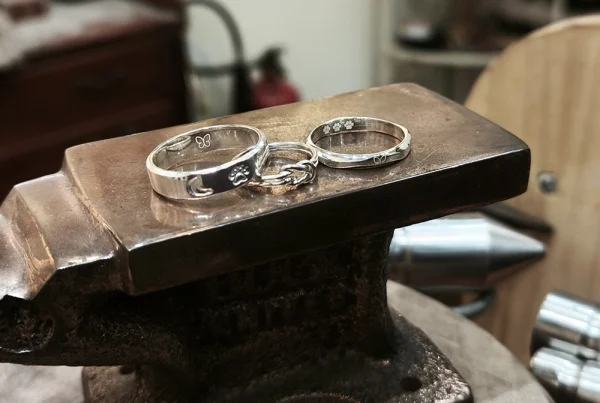
You look at a simple silver ring and think, “How hard can that be?”
It’s round.
It’s shiny.
It’s probably only a few millimeters wide.
Then someone puts a piece of silver in your hand and asks you to make one.
Suddenly, that innocent little ring becomes a surprisingly serious opponent.
At Ddreamer Jewelry Making Studio in Ho Chi Minh City, we see this happen all the time.
The First Lesson: Silver Does Not Care About Your Plans
The metal has its own rules
People arrive excited to make their own jewelry. Some have never touched a jeweler’s saw. Others have never held a file properly. A few arrive with the confidence of someone who has watched three jewelry videos on Instagram.
One of the best things about teaching beginners is watching them discover that metal has its own rules.
You can’t just force it to do whatever you want.
A jeweler’s saw is a perfect example.
It looks like a tiny, harmless little saw. You put the blade into the frame, hold your silver, and start cutting.
Simple, right? Not quite.
Many beginners instinctively push the saw forward. Others twist it. Some start moving it around like they’re trying to win a fight with the silver.
The result is usually the same.
Snap!!
There goes the blade.
Sometimes they look at us as if the tool has personally betrayed them. It hasn’t.
The saw is simply teaching the first rule of jewelry making:
Control beats force.
You need a steady rhythm. You need to let the blade do the cutting. You need to control the movement instead of trying to overpower the metal.
And once you get it right, it suddenly feels easy….Until you break another blade….It happens.
Then There’s Filing
Filing is another one that looks completely straightforward.
- Put file against metal.
- Move file.
- Metal disappears.
Easy.
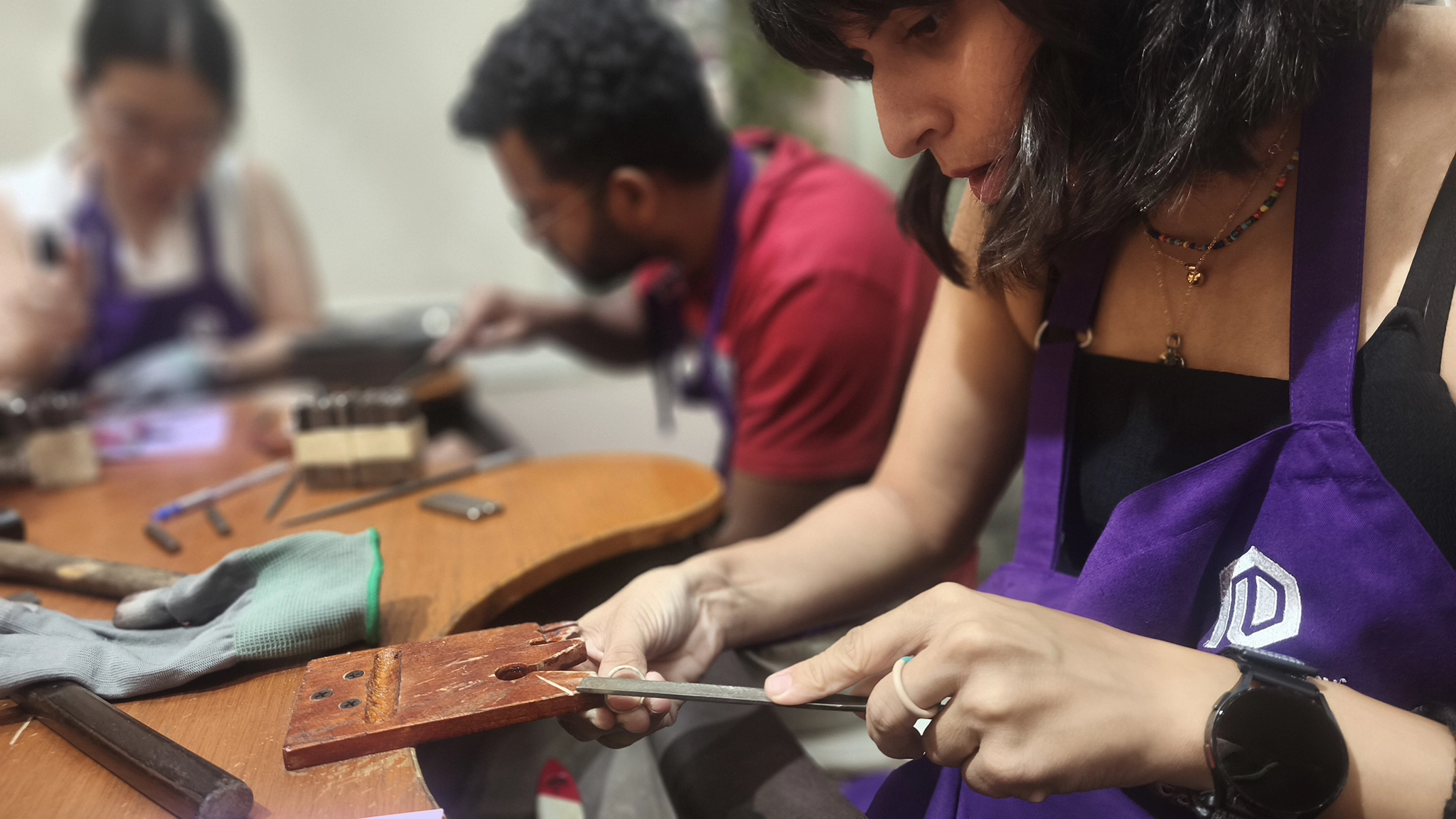
Except that beginners often start filing in the air, holding the silver somewhere between their fingers while waving the file around.
It looks less like jewelry making and more like someone filing their fingernails.
We totally understand why they do it.
They simply haven’t learned yet that the bench pin is there to help them.
The Bench Pin

- The piece needs support.
- Your body needs support.
- Your hands need a stable position.
Once the silver is properly supported against the bench pin, the same movement suddenly becomes much more controlled.
This is why we spend quite a bit of time explaining the bench pin itself.
Our bench pins aren’t random pieces of wood with a V cut into them.
I make and modify ours myself.
Every little notch, groove, edge and opening has a purpose. Different parts are designed to support different movements and different pieces of work.
There are positions that work better for certain cuts with the saw. Other positions work better for filing. Some are designed around how the metal needs to sit.
And we make sure both left-handed and right-handed guests can find a comfortable way to work.
To someone who has never used one, it’s just a funny-looking piece of wood.
To a jeweler, it’s basically another hand.
Your Non-Dominant Hand
Suddenly Gets a Job

There’s another surprise waiting for beginners.
Your weaker hand is going to get tired.
A lot.
When you’re working at a jewelry bench, your non-dominant hand often has to hold a tiny piece of silver completely still while your other hand does the actual work.
Most people aren’t used to this.
We don’t normally spend our days clamping tiny pieces of metal between our fingers.
So after a while, the hand holding the silver starts complaining.
This is also why people sometimes hold their work in positions that look completely ridiculous.
They think they’ve found a clever way to hold the piece.
We watch for a few seconds.
Then we usually say something like, “Okay, let’s try this instead.”
- Sometimes it’s a simple change of position.
- Sometimes we show them another technique.
- Sometimes we physically guide their hands.
And sometimes we have to figure out a completely different way of holding the piece.
The important part is that we don’t expect every person to work exactly the same way.
People have different hands, different strength, different dexterity and different ways of understanding movement.
Good teaching means noticing that.
The opposite happens too.
Some People Need More Challenge
Some guests arrive with excellent hand control.
They pick up the tools and immediately understand how their hands need to move.
For those people, simply getting through the basic steps isn’t enough. They need a little more of a challenge. So we increase the difficulty.
Maybe the design has a more complex pattern. Maybe there are geometric surfaces that need to be filed very accurately. Maybe we give them a technique that requires more control. Sometimes we challenge them with something as simple as placing tiny pieces of solder along the edge of a ring.
It sounds easy…but it isn’t.
You need a very steady hand, especially when you’re balancing something tiny on something even tinier.
We normally follow a simple teaching process.
- Try it first.
- Then we explain.
- We demonstrate.
Sometimes I draw it out on paper right there at the bench.
Then we watch them do it.
If something isn’t working, we correct it or suggest another way. The aim isn’t to make the workshop difficult for the sake of it.
It’s to make sure people actually learn something.
Not everyone has the same hand control.
Some People Need a Completely Different Approach
We’ve had guests with limited hand function, reduced strength, or simply less confidence using their hands.
We don’t want to take the work away from them.
We want to find a way for them to do it.
That might mean changing the way they hold the piece.
- It might mean creating a simple tool to help clamp something.
- It might mean changing the order of the steps.
- Or it might mean physically guiding their hands until the movement makes sense.

One of our guests, Thomas, had reduced function in one hand. We created and adapted tools so he could still do most of the work himself.
That’s something we’re quite proud of.
Because the point isn’t that everyone has to work like a professional jeweler.
The point is that you should be able to make as much of your own piece as possible.


Some Jewelry Is Surprisingly Physical
People sometimes imagine jewelry making as delicate little movements performed with delicate little tools.
Some of it is…Some of it isn’t.
If you’re starting with an ingot and turning it into a ring band, you may be rolling and forming silver for quite some time.
Or if you’re working with silver wire, you may need to pull it through a drawplate to reduce its size, by force.
That’s not a delicate little task. That’s you versus a piece of silver.
Then there is hammering.
Certain textures require repeated blows, and keeping the pattern consistent can become tiring. You need rhythm and you need control. You need enough force to create the mark without completely destroying the design.
And yes, your arms definately will feel it.
We also ask guests something before they start:
“Have you eaten?”
It sounds like a strange question before a jewelry workshop.
It isn’t.
Depending on the piece you’re making, you’ll need energy and concentration.
If you’ve spent the whole morning walking around Ho Chi Minh City, eaten nothing since breakfast, slept four hours, and then decide to spend two hours concentrating on tiny pieces of metal, you’re making life unnecessarily difficult for yourself.
Eat something first.
Trust us.
Your body will thank you.
Then There Is the Heat


Silver conducts heat very well. This is wonderful when you’re working with it.
It is less wonderful when you’re holding the other end. After a lot of sawing or filing, the metal can become surprisingly warm.
Then you move into soldering. Now your attention needs to go up another level.
You are working with a torch and a tiny piece of solder. You need to watch the metal. Watch the heat. Watch where the solder is.
And hopefully keep your fingers out of places they shouldn’t be. Sometimes the solder decides it would rather explore the workshop.

Even the “Simple” Rings Aren’t Always Simple
One of the funniest things about jewelry making is that appearance can be very misleading.
Some rings, earrings, pendants or bracelets look complicated but are actually quite straightforward to construct.
Others look incredibly simple.
Then you start making one and realize that every surface needs to be filed to the right angle. Or every edge needs to line up. Or the geometric faces need to meet properly.
Suddenly your “simple jewelry piece” has become a tiny engineering project.
This is why we sometimes suggest that beginners don’t start with the most ambitious design they see. We ask them to make something manageable first. To learn how long the process actually takes. Learn how your hands work.
Get comfortable with the tools. And then come back for something harder.
There is nothing wrong with discovering that the jewelry piece you initially wanted is probably better saved for your second workshop.
In fact, that’s often when people realize how much they’ve already learned.
When the Concentration Takes Over
There is a moment during almost every workshop when the room changes
At the beginning, everyone is talking. People are asking questions.
They’re looking around. They’re figuring out the tools.
Then someone starts sawing. Another person begins filing. Another is playing with the fire. Someone else is carefully placing a tiny piece of solder…. And gradually, the conversation gets quieter.
Everyone is concentrating.
This is one of my favorite parts. Because you can actually see people learning.
The hands become more confident, the movements become smaller, the tools stop feeling strange.
Something that looked awkward twenty minutes earlier suddenly becomes natural.
And then someone looks up and says:
“This is actually much harder than I thought.”
Usually followed by:
“But I’m really having a lot of fun!”
That’s the moment we want.
Not because we want to make you suffer through a difficult workshop.
But because overcoming a small challenge makes the finished piece mean way more.
And Then You Polish It
After all that work, you finally reach the finishing stages.
- You’ve made the shape.
- You’ve added texture and stamps.
- You’ve solder your piece.
- You’ve corrected the mistakes.
- You’ve filed the edges.
- You’ve sanded the surfaces.
Now you polish it.
This is where the transformation happens.
The slightly battered piece of silver you’ve been fighting with for the last couple of hours suddenly starts shining.
It catches the light. The texture becomes clearer. The edges feel smooth.
And suddenly it looks like jewelry.
Not practice jewelry.
Not something you made “for an activity.”
Actual jewelry.
Something you can wear. Something you can give someone. Something you can keep.
And you know exactly how it got there.

That’s Why Making It Yourself Feels Different

One of our guests described the experience as a chance to appreciate the wonderful and precise work behind handmade jewelry.
“You learn to admire the wonderful and precise work of handmade jewellery.”
— Orelyn, Germany
That’s one of the things we hope people take away. You leave with the jewelry, of course… But you also leave understanding a little more about what goes into making it.
You know why a flat edge is difficult. You know why a perfectly round ring isn’t automatically easy. You know why a tiny solder joint can require so much concentration. You know why a jeweler sometimes spends an absurd amount of time filing something that looks completely insignificant.
And perhaps you’ll look at handmade jewelry differently after that.
You’ll see the time spent and work behind it.

You Don’t Have to Be Good at It
This might be the most important thing.
You don’t need good hands. You don’t need artistic talent. You don’t need to be a patient person (well, just a little bit). You don’t need to know anything about jewelry.
You just need to be willing to try.
We’ll adapt the way we teach you. We’ll give you more help when you need it. We’ll give you more of a challenge when you’re ready. We’ll show you another way when the first way doesn’t work.
And we’ll probably make a few terrible jokes along the way.
Because jewelry making should be taken seriously. But it doesn’t mean we have to take ourselves too seriously.
The metal will already do enough of that for us.
That’s Why Making It Yourself Feels Different

If there’s one thing we’d tell anyone before they sit down at our bench, it’s this:
Be patient. Trust the process.
Because, some pieces take time, techniques take practice, or some designs look simple but aren’t. Sometimes the silver fights you … repeatedly. Sometimes your hands get tired, or your shoulder, or your leg….or your back…
Sometimes you break a saw blade and stare at it wondering what just happened. Sometimes your piece is flung around by the sheer force of the sanding drum. Or bashed against the plexiglass cage of the polisher machine..
But then you try again.
And eventually, you look down at the finished piece.
It’s hyper shiny. It’s yours. You Made IT. It’s so Bling bling!
And you know exactly how much work went into it. That’s when you understand why jewelry making is harder than it looks.
And why, once you’ve made something yourself, it just feels so much better to wear.