Why Moissanite Is the Perfect Choice for Engagement Rings
Choosing an engagement ring is one of the most important and meaningful decisions a couple will make.
With so many options available, it can be overwhelming to find the perfect ring that captures the essence of your love story. However, there is one gemstone that stands out as the ideal choice: Moissanite.

Moissanite is a captivating and durable gemstone that has gained increasing popularity in the world of engagement rings. Offering unparalleled beauty, affordability, and ethical considerations, moissanite is quickly becoming the go-to choice for couples seeking a ring that truly reflects their unique love.
The Allure of Moissanite
A Gemstone from the Stars

Moissanite is a captivating gemstone with a fascinating origin story. Discovered in 1893 by the French scientist Henri Moissan in a meteorite crater, this remarkable stone was initially misidentified as diamond.
It wasn’t until 1904 that Moissan confirmed its true identity as silicon carbide. This rare mineral, found in nature only in minute quantities, sparked interest for its unique properties and beauty.
From Meteorites to Market
While natural moissanite is exceedingly rare, advancements in technology have allowed scientists to recreate this stunning gemstone in laboratories. Today, the vast majority of moissanite available on the market is lab-grown, making it not only more accessible but also a sustainable choice for jewelry lovers. This synthetic production process ensures that consumers can enjoy the beauty of moissanite without the ethical concerns sometimes associated with mined gemstones.
A Dazzling Alternative to Diamonds
One of the most remarkable aspects of moissanite is its striking visual similarity to diamonds. With its brilliant sparkle, fire, and overall brilliance, moissanite can rival even the most flawless diamonds. In fact, moissanite boasts a higher refractive index—between 2.65 and 2.69—compared to diamonds at 2.42. This means that moissanite can produce more colorful flashes of light, creating an enchanting display that many find irresistible.
Durability Meets Affordability
In addition to its stunning appearance, moissanite is also incredibly durable. It ranks 9.25 on the Mohs scale of hardness (where diamonds score a perfect 10), making it an excellent choice for everyday wear. Whether you’re looking for an engagement ring or a statement piece, moissanite offers both beauty and resilience.
The Price Factor
Another significant advantage of moissanite is its affordability. Compared to diamonds, which can carry hefty price tags due to their rarity and demand, moissanite provides a cost-effective alternative without compromising on quality or aesthetics. This makes it an attractive option for those seeking elegance on a budget.
Unmatched Durability and Affordability
The Perfect Blend
When it comes to choosing the perfect gemstone for an engagement ring or a cherished piece of jewelry, durability and beauty are often at the top of the list.
Enter moissanite—a gemstone that not only dazzles with its brilliance but also stands the test of time.
With its remarkable properties, moissanite has become a favored choice for those who desire a stunning yet resilient option.

Unmatched Durability
Moissanite is not only visually stunning but also incredibly durable, making it an ideal choice for those seeking a long-lasting gemstone. With a hardness rating of 9.25 on the Mohs scale, moissanite stands just below diamonds, which score a perfect 10.
This exceptional hardness means that moissanite is highly resistant to scratches, chips, and other forms of damage, ensuring that your engagement ring or jewelry piece will maintain its breathtaking appearance for years to come.
The durability of moissanite makes it perfect for everyday wear. Whether you’re engaged in daily activities, enjoying outdoor adventures, or attending special occasions, you can wear your moissanite jewelry with confidence.
Its resilience allows it to withstand the rigors of daily life without losing its luster or beauty. You can enjoy your beautiful piece without constant concern about wear and tear, making it a practical yet elegant choice.
A Lifetime of Sparkle
In addition to its impressive hardness, moissanite exhibits exceptional brilliance and fire. Its unique optical properties allow it to reflect light in a way that creates a captivating sparkle, often rivaling that of diamonds.
This means that not only is your moissanite jewelry built to last, but it will also continue to shine brightly through the years, serving as a constant reminder of special moments and cherished memories.
Ethical and Sustainable Considerations
Embracing Ethical Choices

In recent years, there has been a growing awareness and concern about the ethical and environmental impact of the diamond industry.
Documentaries, news reports, and social media campaigns have shed light on the darker side of diamond mining, revealing issues such as human rights abuses, labor exploitation, and significant environmental degradation.
As a result, many consumers are now actively seeking alternatives that align with their values and prioritize sustainability in their purchasing decisions.
The Ethical Dilemma
The traditional diamond industry has long been associated with a range of ethical dilemmas.
From conflict diamonds—often referred to as “blood diamonds,” which are mined in war zones and sold to finance armed conflict—to the environmental destruction caused by open-pit mining, the consequences of diamond extraction can be severe.
Moreover, many mines operate under conditions that exploit workers, often involving child labor and inadequate safety measures. These revelations have prompted a shift in consumer behavior, with more individuals looking for ways to make responsible choices when it comes to significant purchases like engagement rings.

Moissanite: A Responsible Choice
Enter moissanite—a stunning gemstone that offers an ethical alternative to traditional diamonds. Moissanite is produced in a laboratory setting, which eliminates the need for mining altogether.
This innovative process not only prevents the potential for human rights abuses associated with diamond extraction but also significantly reduces environmental impact.
By choosing moissanite, couples can celebrate their love with a ring that reflects their commitment to ethical practices and sustainability.
The production of lab-grown moissanite is carefully regulated, ensuring that it is created under conditions that prioritize both quality and responsibility.
This means that consumers can enjoy the beauty and brilliance of moissanite without the ethical concerns tied to mined gemstones.
Additionally, lab-grown gems often have a lower carbon footprint compared to their mined counterparts, making them a more environmentally friendly option.
Aligning Values with Choices
For many couples, an engagement ring is not just a piece of jewelry; it symbolizes their values and commitment to each other. By selecting moissanite, they can express their love while also making a statement about their dedication to ethical consumerism.
This choice resonates particularly well with millennials and Gen Z consumers, who are increasingly prioritizing sustainability and social responsibility in their purchasing decisions.
Moreover, moissanite’s affordability allows couples to invest in larger or higher-quality stones without compromising their budget. This means they can choose a stunning piece that aligns with their ethical principles while still enjoying the luxury and beauty they desire.
Customize Your Dream Engagement Ring with Ddreamer Jewelry
Are you searching for an engagement ring that truly reflects your love and style?
Design a one-of-a-kind ring featuring the stunning brilliance of moissanite.
Bring your vision to life, ensuring your engagement ring is as unique as your relationship.
Understanding Karats in Moissanite
A Common Question
One common question about moissanite engagement rings is whether they have karats like diamonds.
The short answer is no—moissanite does not have a karat measurement.
Understanding the differences in how these two gemstones are measured can help you make an informed choice when shopping for an engagement ring.

Key Differences Between Moissanite and Diamonds
- Measurement Units:
- Diamonds: Measured in karats, which refers to the weight of the diamond. One karat is equal to 0.2 grams. The karat weight significantly influences a diamond’s value and price.
- Moissanite: Measured by its size or diameter, typically in millimeters (mm). When shopping for a moissanite engagement ring, focus on the size of the stone rather than its karat weight.
- Size Comparison:
- A 1-carat moissanite stone will generally appear larger than a 1-carat diamond due to its lower density. Moissanite weighs about 10-15% less than diamonds, meaning you get a larger appearance for the same weight.
- Brilliance and Fire:
- Moissanite has a higher refractive index than diamonds, which gives it more brilliance and fire. This means that a moissanite stone can appear even more sparkling and colorful compared to a diamond of the same carat weight.
Moissanite Size Chart
To help visualize the differences in size and equivalent weights, here’s a simplified visualization of what normally it looks like, however the complete list is too long to post. Also, the carats vary depending on the stone cut.
| Moissanite Size (mm) | Approximate Diamond Equivalent Weight (ct) |
|---|---|
| 3.00 x 2.00 | 0.10 |
| 4.00 x 3.00 | 0.20 |
| 6.00 x 4.00 | 0.50 |
| 7.70 x 5.70 | 1.00 |
| 8.00 x 6.00 | 1.25 |
| 9.00 x 6.50 | 1.75 |
| 10.00 x 7.50 | 3.25 |
Considerations When Choosing Moissanite
-
- Visual Appeal: When comparing moissanite and diamond rings, consider how the size and brilliance of moissanite can enhance your overall aesthetic preference.
- Pricing: Moissanite typically costs significantly less than diamonds, often up to 90% less for comparable sizes, making it an attractive option for budget-conscious couples.
- Customization: Since moissanites are often cut differently than diamonds, you may want to specify the exact millimeter measurements when ordering your ring to ensure it meets your expectations.

Moissanite Cuts and Colors
When choosing a moissanite for your engagement ring, understanding the available cuts and colors is essential. Moissanite comes in various options to suit different preferences and styles.
Popular Moissanite Cuts

Round Brilliant
The most popular choice, known for maximizing sparkle and fire

Oval
An elegant elongated shape that can make fingers appear slimmer

Princess
A square cut with sharp corners, perfect for modern designs

Cushion
A square or rectangular shape with rounded corners, offering vintage appeal

Pear
A teardrop shape that combines round and marquise cuts

Emerald
A rectangular step-cut that emphasizes clarity and elegance

Radiant
A rectangular or square shape with cut corners, offering brilliant sparkle

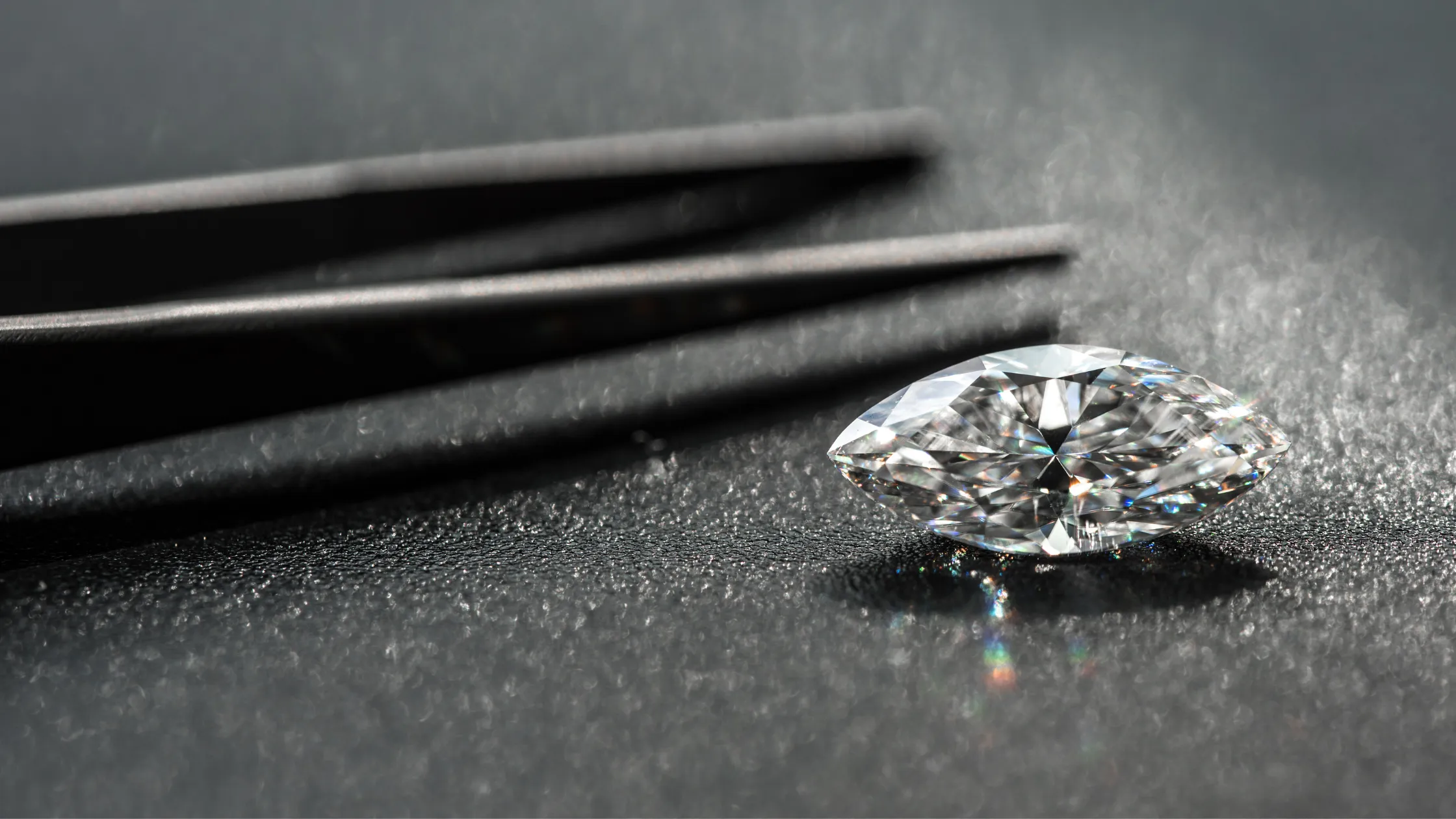
Marquise
An elongated shape with pointed ends, creating a dramatic look

Asscher
A square step-cut with a vintage Art Deco feel

Heart
A romantic symbol, perfect for unique engagement rings
Moissanite Color Options
Moissanite is available in several color grades:
Colorless (D-E-F)
|
Near-Colorless (G-H-I)
|
Faint Color (J-K)
|
Fancy Colored Moissanite
|
Quality Considerations
When selecting a moissanite, consider these factors:
- Cut Quality: The cut affects the stone’s brilliance and fire. Premium cuts will display optimal light performance.
- Clarity: Most moissanite is eye-clean, meaning no visible inclusions to the naked eye.
- Size: Remember that larger stones may show more color, especially in fancy cuts.
- Setting: Different cuts and colors work better with certain setting styles. For example:
- Colorless stones work best in white gold or platinum
- Warmer stones pair beautifully with rose or yellow gold
- Certain cuts require specific prong configurations for security
Care Tips Based on Cut and Color
Different cuts may require slightly different care approaches:
- Step-cut stones (Emerald, Asscher) may show oils and dirt more easily
- Pointed cuts (Marquise, Pear) need protective settings to prevent chipping
- Brilliant cuts are generally easier to maintain and clean
Moissanite vs. Swarovski Diamonds
Key Differences to Consider

When it comes to choosing a gemstone for an engagement ring or other fine jewelry, many people find themselves comparing moissanite with Swarovski diamonds.
While both options offer a beautiful aesthetic, they differ significantly in terms of composition, durability, brilliance, and cost. Understanding these differences can help you make a better informed decision that aligns with your preferences and values.
Key Differences
1. Origin and Composition
- Moissanite:
- A naturally occurring mineral, though most moissanite used in jewelry today is lab-created.
- Discovered in 1893 by Henri Moissan in a meteorite crater, giving it a unique cosmic origin story.
- Swarovski Diamonds:
- Entirely synthetic crystals produced by the renowned Swarovski company.
- Crafted from quartz sand and minerals, these stones are designed to mimic the appearance of diamonds.
2. Brilliance and Fire
- Moissanite:
- Exhibits a higher refractive index (2.65-2.69) than diamonds, resulting in greater brilliance and fire.
- Known for its eye-catching sparkle and colorful flashes of light.
- Swarovski Diamonds:
- While still visually appealing, they have a lower refractive index (approximately 1.52), which means they do not exhibit the same level of brilliance as moissanite.
3. Durability
- Mohs Hardness:
- Moissanite: Ranks at 9.25 on the Mohs scale, making it nearly as hard as diamonds (10). This high hardness means it is resistant to scratches, chips, and other damage.
- Swarovski Diamonds: Have a Mohs hardness of around 6-7, making them less durable and more prone to scratches over time.
4. Cost Comparison
- Moissanite:
- Generally costs significantly less than traditional diamonds—up to 90% less for comparable sizes.
- Offers excellent value for couples looking for a stunning engagement ring without the hefty price tag.
- Swarovski Diamonds:
- Typically more expensive than natural diamonds when considering their quality and craftsmanship.
- While they may be affordable compared to diamonds, they do not provide the same long-term value as moissanite.
Comparison Table: Moissanite vs. Swarovski Diamonds
| Feature | Moissanite | Swarovski Diamonds |
|---|---|---|
| Origin | Naturally occurring (lab-created) | Synthetic |
| Refractive Index | 2.65-2.69 | ~1.52 |
| Mohs Hardness | 9.25 | 6-7 |
| Brilliance | Higher | Lower |
| Durability for Daily Wear | Excellent | Moderate |
| Price Range | Up to 90% less than diamonds | Generally higher than natural diamonds |
| Color Options | Limited (clear/near-colorless) | Wide range of colors |
| Long-term Value | High | Moderate |
Elevate Your Style with Bespoke Moissanite Jewelry
Seeking a special piece of jewelry that captures your individual flair?
Explore DDreamer Jewelry’s custom moissanite jewelry services.
Let us craft for you a truly remarkable, one-of-a-kind accessory.
Embrace the Brilliance of Moissanite
Choosing Moissanite for Your Engagement Ring
In conclusion, when it comes to selecting the perfect engagement ring, moissanite emerges as an exceptional choice for several compelling reasons:
Unparalleled Beauty:
Moissanite boasts superior brilliance and fire, often outshining both diamonds and Swarovski crystals. Its higher refractive index means it sparkles with a captivating intensity.
Durability:
With a Mohs hardness of 9.25, moissanite is incredibly durable, making it ideal for everyday wear. It can withstand the rigors of daily life while maintaining its stunning appearance over time.
Affordability:
Moissanite can cost up to 90% less than traditional diamonds, providing an affordable option without sacrificing beauty or quality. This allows couples to invest in larger stones or additional pieces of jewelry within their budget.
Ethics:
As a lab-created gemstone, moissanite is an ethically sourced alternative to mined diamonds. Choosing moissanite means you can celebrate your love with a ring that aligns with sustainable and responsible practices.
Making an Informed Decision
Understanding the differences between Moissanite, Diamonds, and Swarovski crystals is crucial in making your choice:
Measurement:
Unlike diamonds, which are measured in carats, moissanite is measured by size (in millimeters). This means you can find a stunning moissanite stone that fits your aesthetic desires while aligning with your values.
Personal Preferences:
Ultimately, your choice will depend on your aesthetic preferences, budget, and how you plan to wear the jewelry. While moissanite shines as the clear winner for engagement rings due to its durability and brilliance, Swarovski crystals may be suitable for fashion jewelry that won’t see daily wear.
The centerpiece of your love story
In summary, whether you’re drawn to the radiant sparkle of moissanite or considering other options like Swarovski crystals, moissanite stands out as a symbol of everlasting commitment.
Let it be the centerpiece of your love story—offering beauty, value, and peace of mind as you embark on this exciting journey together.
Sources: SofiaLior– HowStuffWorks